
When businesses start looking at health and safety training, one of the first things they Google is the HIRA price. It is a fair starting point. Budgets are tight, training calendars are packed, and every line item needs to justify itself. But here’s the thing: Framing HIRA purely as a cost is looking at it through the wrong lens entirely. The more useful question is what it costs your business when hazards go unidentified and risks go unmanaged. That number is likely to be far higher than any training fee you will ever pay.
If you are running a business and looking to cut spending, the instinct to scrutinise every training line item makes sense. You want a tight, compliant, above-board operation, and you need every investment to bring return on investment. HIRA training does just that. This post unpacks the financial logic behind HIRA training, explains where the real savings come from, and helps you understand what to look for when comparing HIRA course prices across providers.

Under the Occupational Health and Safety Act 85 of 1993, employers are required to conduct formal hazard identification and risk assessments. This is not a once-off exercise. HIRA must be carried out annually, and again whenever working conditions change, whether that means new equipment, revised work processes, additional staff, or a change in premises.
A structured HIRA process spots hidden dangers before a worker gets hurt, which means you are not dealing with injury claims, medical bills, or the grief of a preventable incident after the fact. It also keeps production and operations running without the costly stoppages that follow an unplanned incident. Whether your business operates on a factory floor, on a construction site, in an office, or in the field, the principle is the same: Unmanaged risk eventually disrupts work.
There is a cultural dimension too. When employees see that their employer is genuinely invested in identifying and resolving hazards, trust increases. That trust reduces staff turnover, improves morale, and makes it easier to attract and retain the kind of people who take their work seriously. A strong health and safety culture has a positive impact on your bottom line.
A credible HIRA process follows a structured sequence. Absolute Health Services has published a detailed breakdown of the five steps of a risk assessment on the AHS blog, and it is worth reading in full. In short, the five steps of a HIRA are as follows:
Step 1: Identify hazards
Identify potential workplace hazards through employee consultation, inspections, checklists and manufacturer guidance, including hazards that may cause long-term health effects.
Step 2: Identify who may be at risk
Determine who could be affected by each hazard, paying particular attention to visitors and employees who may be more vulnerable or less familiar with workplace risks.
Step 3: Evaluate risks and decide on precautions
Assess each risk and implement reasonably practicable controls to eliminate or reduce it, using PPE as a last resort where necessary.
Step 4: Record and implement findings
Document the risk assessment, share the findings with the management team and implement the agreed control measures.
Step 5: Review and update the risk assessment
Regularly review the risk assessment to ensure controls remain effective and to identify new or changing workplace hazards.
Each of these steps requires the person conducting the assessment to have the knowledge to do it properly. That is exactly what HIRA training provides.
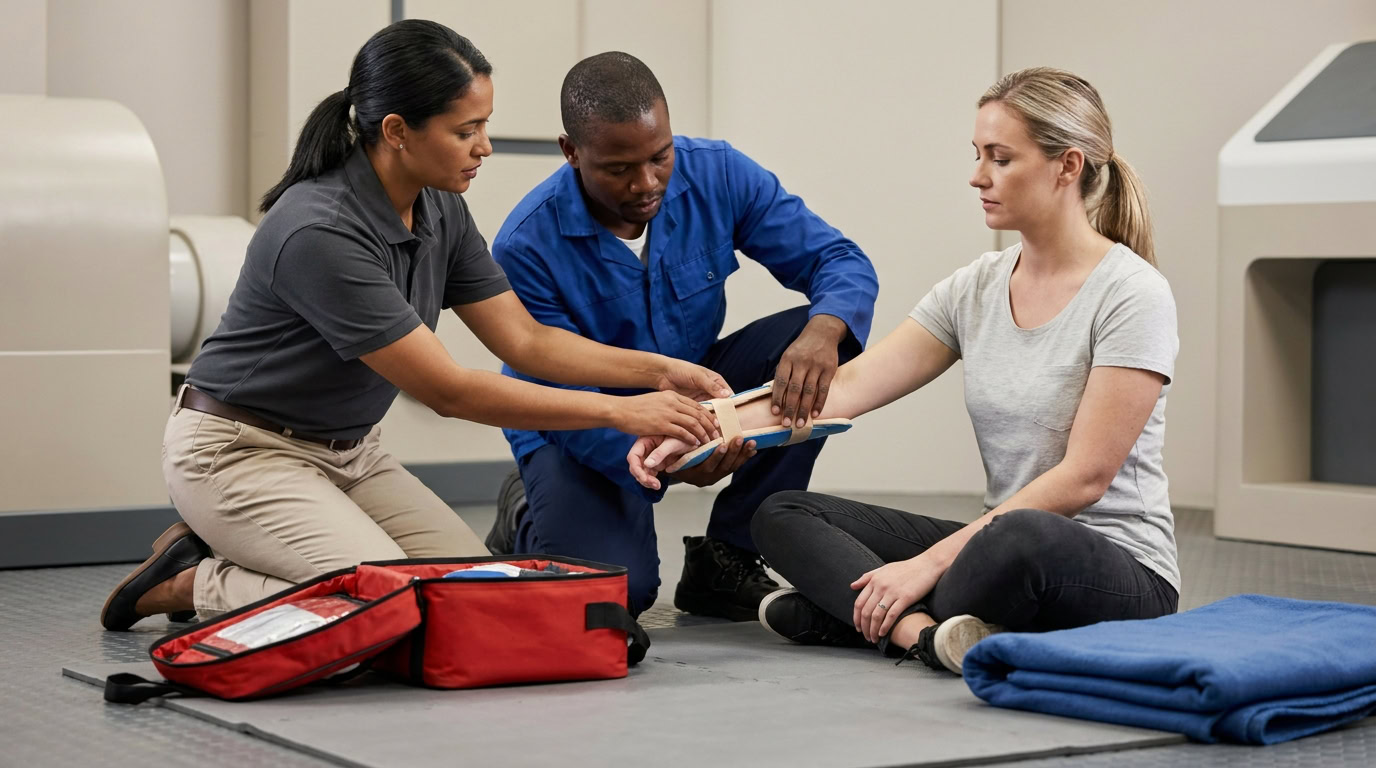
Before we get to what training costs, consider what non-compliance costs. The financial consequences of skipping or inadequately conducting a risk assessment (HIRA) fall into several categories.
Workplace accident costs include medical treatment, compensation claims, and death or disability payments. These costs are usually insured. However, there are additional uninsured costs that amount to much more than the insured costs: Lost productivity, overtime to cover absent workers, training costs for stand-in workers, property damages, repairs, reduced staff morale, and the administrative burden of incident investigation and reporting. These costs accumulate quickly and can be a significant blow to your business.
Legal fines and penalties are a real risk. The Occupational Health and Safety Act 85 of 1993 gives Department of Employment and Labour inspectors the authority to issue notices or fines if your workplace is inspected and found to have no documented risk assessments. Additionally, if negligence is established in the event of a serious workplace injury, you risk substantial fines, legal action, and even personal criminal liability.
Reputational damage is harder to quantify but has a real impact on the health of your business. A poor health and safety record affects your ability to attract and retain good staff. It also affects your standing with clients, especially if your business competes for contracts with large corporates or government entities where OHS compliance is part of the vetting process.
Unplanned downtime and project delays follow almost every serious incident. Investigations, equipment shutdowns, and the disruption of losing a skilled worker from the team all add time and costs to projects.
Conducting regular risk assessments is a vital aspect of complying with the OHS Act. But risk assessments cannot be done by just anyone; identifying hazards, assessing risks, and suggesting control measures requires specialised knowledge and skills.
When your Health and Safety Representative, Supervisor, or other appointed health and safety team member has been through a proper HIRA course, they’re able to systematically identify hazards and unsafe conditions before an incident occurs. They know what to look for, how to calculate risk levels based on likelihood and severity, how to identify appropriate controls, and how to document and review risk assessments. Assessing and controlling risks in the workplace in this manner is essential to achieving compliance with the OHS Act.
A quality HIRA course covers the legal framework underpinning occupational health and safety in South Africa, the methodology for identifying and classifying hazards, risk evaluation and prioritisation, the development of control measures, and the documentation required to demonstrate compliance. It is practical, structured, and directly applicable to real workplace conditions.
The employees who benefit most from HIRA training include Health and Safety Representatives, Supervisors, Health and Safety Officers, or business owners and managers in smaller organisations.
HIRA course pricing varies depending on the training provider, the format (online or in-person), and the accreditation body. When comparing HIRA training providers, always ensure that they hold either HWSETA (Health and Welfare Sector Education and Training Authority) or QCTO (Quality Council for Trades and Occupations) accreditation.
Absolute Health Services is accredited by both the HWSETA and the QCTO and currently offers the following HIRA training options:
Duration: One day
Format: In-person training (facilitated at our public training centres or on-site at your venue for groups of eight or more delegates)
Accreditation: HWSETA
Price: R975.00 (ex VAT)
Duration: One day
Format: This training is facilitated fully online via Microsoft Teams
Accreditation: HWSETA
Price: R925.00 (ex VAT)
Note that Absolute Health Services is accredited to offer the newly-launched QCTO skills programme, Operational OHS Risk Assessor, and will be adding this skills programme to our regular course roster soon.
Beyond avoiding costs associated with incidents and accidents, HIRA training generates measurable financial returns:
Lower insurance premiums: Businesses with structured, documented HIRA processes and trained health and safety personnel present a lower risk profile to insurers, which can translate into lower monthly premiums.
Retaining good workers: Employees who feel safe at work are more likely to stay. Reducing staff turnover cuts recruitment, onboarding, and retraining costs, and keeps experienced people in your business where their knowledge has value.
Staying compliant and avoiding fines: HIRA training ensures your risk assessment documentation is credible, current, and conducted by someone with demonstrable competency.
At Absolute Health Services, we offer accredited HIRA training designed for real workplaces. Our courses are facilitated by experienced OHS practitioners who understand what compliance looks like in practice, not just in a textbook. We offer flexible delivery options (online, in-person at our training centres, or in-person at your venue), and competitive HIRA course pricing.
Contact Absolute Health Services today for a HIRA course overview, a group quote, or answers to any questions you may have. Our team is ready to help you invest in the health and safety and compliance status of your workplace.
Contact Absolute Health Services now to book your HIRA course, request a quote, or speak to one of our consultants about the right training option for your team.
