
A fire drill (or evacuation drill) is not a box-ticking exercise. Done correctly, it is the most reliable way to find out whether your workplace’s emergency evacuation plan actually works, before a real fire or emergency forces you to find out the hard way. Done incorrectly, or not done at all, it leaves your employees underprepared, your business non-compliant, and your organisation exposed to penalties and legal liability.
South African employers have clearly defined legal obligations when it comes to fire preparedness and evacuation planning. This guide explains what a compliant evacuation drill must include, how to write an evacuation drill report, and the common mistakes that undermine the value of the whole exercise.
Fire drill and evacuation requirements in South African workplaces sit across several overlapping pieces of legislation and standards.
The OHS Act places a general duty of care on all employers under Section 8 to provide and maintain, as far as is reasonably practicable, a working environment that is safe and without risk to the health of employees. This duty extends explicitly to emergency preparedness.
To assist with providing a safe working environment, employers should:
A significant development for fire safety compliance took effect on 6 March 2025, when the Minister of Employment and Labour promulgated amendments to the General Safety Regulations (Government Gazette No. 52226), including the introduction of Regulation 13J: Fire Precaution and Means of Egress.
Regulation 13J places the following specific obligations on every employer, directly from the Gazette:
To expedite the evacuation of a workplace in case of fire, every employer shall ensure that:
Critically, Regulation 14 of the same amendment confirms that contravention of Regulation 13J constitutes a criminal offence, with penalties including a fine, imprisonment of up to six months, or — for a continuing offence — an additional fine of R200 per day or one day of additional imprisonment per day, up to a maximum of 90 days. These are not administrative penalties. They are criminal sanctions.
In addition to the OHS Act, fire safety compliance in South Africa is shaped by:
Municipal Emergency Services and Fire Safety By-laws stipulate a minimum of two evacuation drills per year, a standard that is also aligned with the requirements of most commercial property insurers and principal contractors, and with general industry best practice.
Absolute Health Services conducts fire and evacuation drills for clients on a bi-annual basis, incorporating simulated emergency scenarios to test both the plan and the people responsible for executing it.
A legally sound and genuinely useful fire drill is a structured, documented exercise.
Before the Drill: Preparation
Review and update your emergency evacuation plan Your written evacuation plan should be current, reflecting any changes to the building layout, occupancy, or personnel since the last drill. The plan must identify all emergency exits, assembly points, evacuation routes, and the roles of designated personnel.
Confirm your means of egress are clear and compliant Before the drill begins, physically verify that all emergency exits are unobstructed and that directional signage and emergency lighting are functional.
Confirm firefighting equipment is in place and serviceable Check that fire extinguishers are at their designated locations, in good working order, and that the last service date is within the required maintenance interval.
Plan your simulated scenario Effective drills should incorporate a degree of realism, simulating an actual emergency condition, such as a fire in a specific area.
Inform relevant parties Notify your building management, Health and Safety Team, security personnel, neighbouring businesses, and any emergency services relationships of the planned drill. This avoids the emergency services being activated unnecessarily.
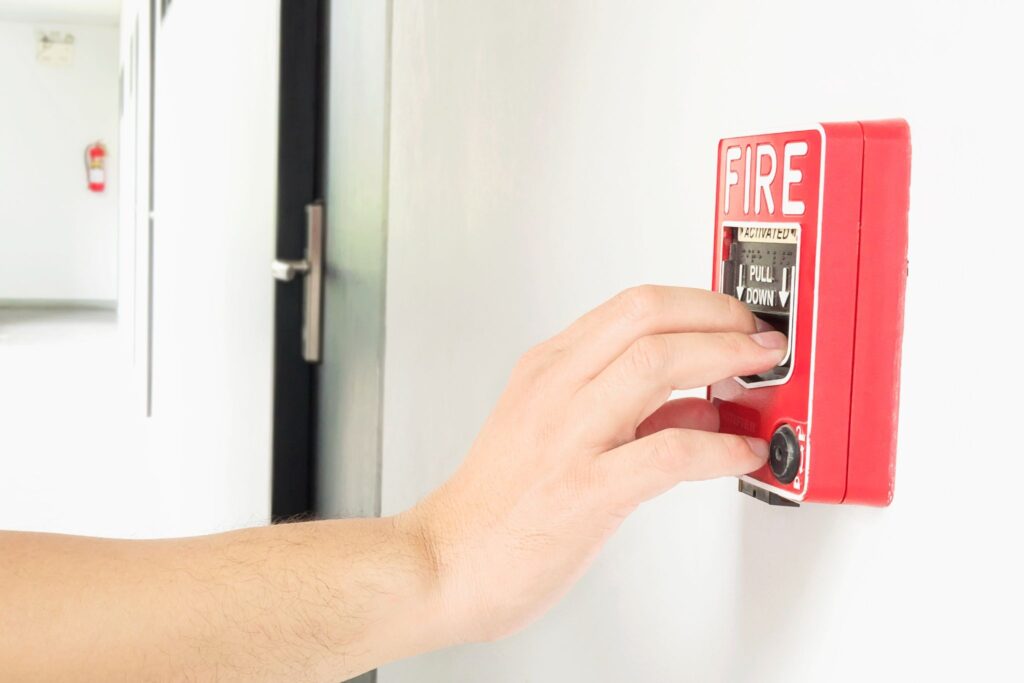
Sound the alarm The drill begins with the activation of the building’s alarm system or other prescribed alarm signal. All employees, as well as contractors, visitors, and delivery personnel on the premises, are expected to respond.
Evacuate the building via designated routes All employees must evacuate to the designated assembly point. Evacuation Marshalls must guide employees and systematically clear their zones, checking bathrooms, meeting rooms, and any areas where employees may be present and unaware of the alarm.
Account for everyone at the assembly point A comprehensive roll call must be conducted at the assembly point. This is one of the most critical elements of the evacuation drill. The time from alarm to full confirmed evacuation should be measured and recorded.
Simulate emergency response procedures Where applicable, simulate the actions your designated Health and Safety Team members would take: notifying emergency services,assisting mobility-impaired individuals who are unable to evacuate independently, and managing the assembly point.
Time the drill Measure and record the total evacuation time from alarm to full confirmed roll call. This is a key performance metric that should improve over successive drills.
Conduct an immediate debrief/post-drill meeting Bring together the Health and Safety Team and relevant members of management to review the drill’s outcomes while observations are fresh. Identify what went well and, more importantly, where the plan or people fell short.
Complete your evacuation drill report A formal evacuation drill report is essential for compliance purposes. It serves as documented evidence that the drill took place and provides a record for DoEL inspections, insurers, and any post-incident investigation.
Your fire or evacuation drill report is a formal compliance document. At minimum, it should capture the following:
This report should be retained as part of your OHS file. Where Absolute Health Services manages a client’s evacuation drills, a formal written report is provided as part of the service, forming part of the client’s documented compliance record.
Many workplaces make the following mistakes when conducting evacuation or fire drills.
Not accounting for all occupants A roll call that fails to account for every person on the premises, including contractors, visitors, and individuals in remote areas of the building, defeats the primary purpose of the drill. Your Evacuation Marshals must be trained to conduct a thorough, systematic evacuation sweep and complete roll call.
Ignoring mobility-impaired or vulnerable employees Your evacuation plan must include provisions for employees who may need assistance during an evacuation. A drill that does not practise these procedures leaves a critical gap. Employers have an obligation to consider the needs of all employees in their emergency planning.
Failing to test blocked or alternative routes Most evacuation drills follow the primary evacuation route. Running drills that simulate a blocked primary exit forces employees and Evacuation Marshals to use alternative routes and practice adaptive decision-making.
Not using the drill to identify physical deficiencies A drill is an opportunity to spot obstructed exits, malfunctioning emergency lighting, inaccessible fire extinguishers, and other physical compliance gaps.
No written report or corrective action follow-up A drill that leaves no written record and generates no corrective actions is a missed opportunity. An evacuation drill report is the mechanism through which your emergency response improves over time, and the evidence that demonstrates your compliance to regulators.
Treating the drill as a disruption rather than a training exercise Cultural resistance to drills — the attitude that they are an interruption to productive work — is a significant barrier to genuine emergency preparedness. When senior management participates actively and takes the evacuation drill seriously, employees follow.
Absolute Health Services provides comprehensive evacuation planning and fire safety training services to South African businesses, helping employers meet their legal emergency preparedness obligations.
Our evacuation drill services include:
Is an evacuation drill legally required in South Africa? Yes. Emergency services by-laws stipulate a minimum requirement of two evacuation drills per year.
How many fire drills are South Africa employers required to conduct per year? Employers are required to conduct a minimum of two evacuation drills per year.
What must a fire drill report include? A fire drill report must capture the date, time, location, number of occupants, evacuation time, fire marshal assignments, alarm method used, observations on routes and equipment, deficiencies identified, corrective actions required, and the signature of the responsible person. It should be retained in your OHS file.
Who should conduct a fire drill? Fire or evacuation drills should be planned and conducted by a competent, designated person, typically your appointed Health and Safety Supervisors/Health and Safety Officer alongside the Health and Safety Team, or a qualified external OHS Practitioner.
