
For many CEOs and operations managers, the concern is not whether health and safety training matters. It is whether the business can afford the downtime to get there. Pulling staff away from their posts, even for a day, has real consequences: Deadlines shift, output drops, and the pressure falls on whoever is left behind. This is a legitimate operational concern, but the good news is that compliant, accredited training does not have to mean disruption. With the right course formats, scheduling approach, and delivery model, businesses can meet their OHS Act obligations without bringing operations to a standstill.
Understanding which courses apply to your workplace is the starting point for any training plan. Below is an overview of the core health and safety courses required to achieve compliance with the Occupational Health and Safety (OHS) Act.
Basic First Aid (Level 1) (two days)
Firefighting (one day)
Evacuation Planning (one day)
Incident Investigation (one day)
Health and Safety Supervisor (two days)
Ergonomics in the Workplace (2.5 hour online workshop)

Use the strategies below to create a health and safety training schedule that minimises business disruption:
Audit first: Identify which roles require which courses, and check when existing certificates expire.
Map your quiet periods: Most businesses have predictable slow periods, whether monthly, seasonal, or between project phases. Build your training calendar around these windows.
Build in rotation: Divide teams into cohorts and stagger sessions across different dates. Half the team trains this week, the other half the next. No department needs to completely shut.
Align with shift cycles: For shift-based environments, schedule sessions on rest-cycle days so that training does not cut into active production shifts.
Book well in advance: Providers who publish course dates well in advance give you the flexibility to plan around operations rather than react to availability.
Providers like Absolute Health Services run public course dates throughout the month and across the entire year. That frequency gives businesses the flexibility to split their workforce across different sessions rather than sending everyone at once. Send half your team this week and the other half next week. Your operation keeps moving, your compliance obligations are met, and no single department is left completed unmanned. For shift-based environments, cohorts can be aligned with existing shift rotations so that training slots fall on rest cycles rather than active shifts.
For some business models, training the entire team on the same day may make more operational sense. If your business operates across multiple cities, coordinating occupational health and safety training can feel logistically impossible. However, choosing a provider with training centres countrywide allows all your teams to attend the same course on the same day, at locations convenient to each. Your entire workforce can be upskilled simultaneously without the travel costs or the disruption of moving people between sites.
Providers who publish course dates well in advance give businesses the runway they need to schedule training during slower operational periods. Popular health and safety courses, like first aid, firefighting, and Health and Safety Representative, are run multiple times per month, all year round, giving you the freedom to pick dates that coincide with your quietest periods. Whether your quieter period falls at a particular time of the month, between project phases, or during a seasonal slowdown, there will be a course date that fits.
For larger teams, on-site delivery is often the most practical solution. A provider comes to your premises and delivers training in your environment, eliminating travel time entirely and removing the cost of getting staff to a training centre. On-site delivery also means the training happens in the actual environment where employees will apply what they learn, which adds practical relevance. Many businesses find that on-site group delivery is the most convenient option.
Absolute Health Services offers on-site training delivery for businesses that prefer this model (for groups of eight or more delegates per course).
Some health and safety training courses are available online, reducing travel time, costs, and operational disruption even further. Absolute Health Services offers a range of courses that are delivered online via Microsoft Teams, including (but not limited to) Health and Safety Representative, Health and Safety Supervisor, HIRA, Incident Investigation, Evacuation Planning, and Ergonomics in the Workplace.
Note that some important courses necessary for compliance with the OHS Act cannot be facilitated online. These include first aid and firefighting, as both courses include essential practical skill components that can only be facilitated in person.
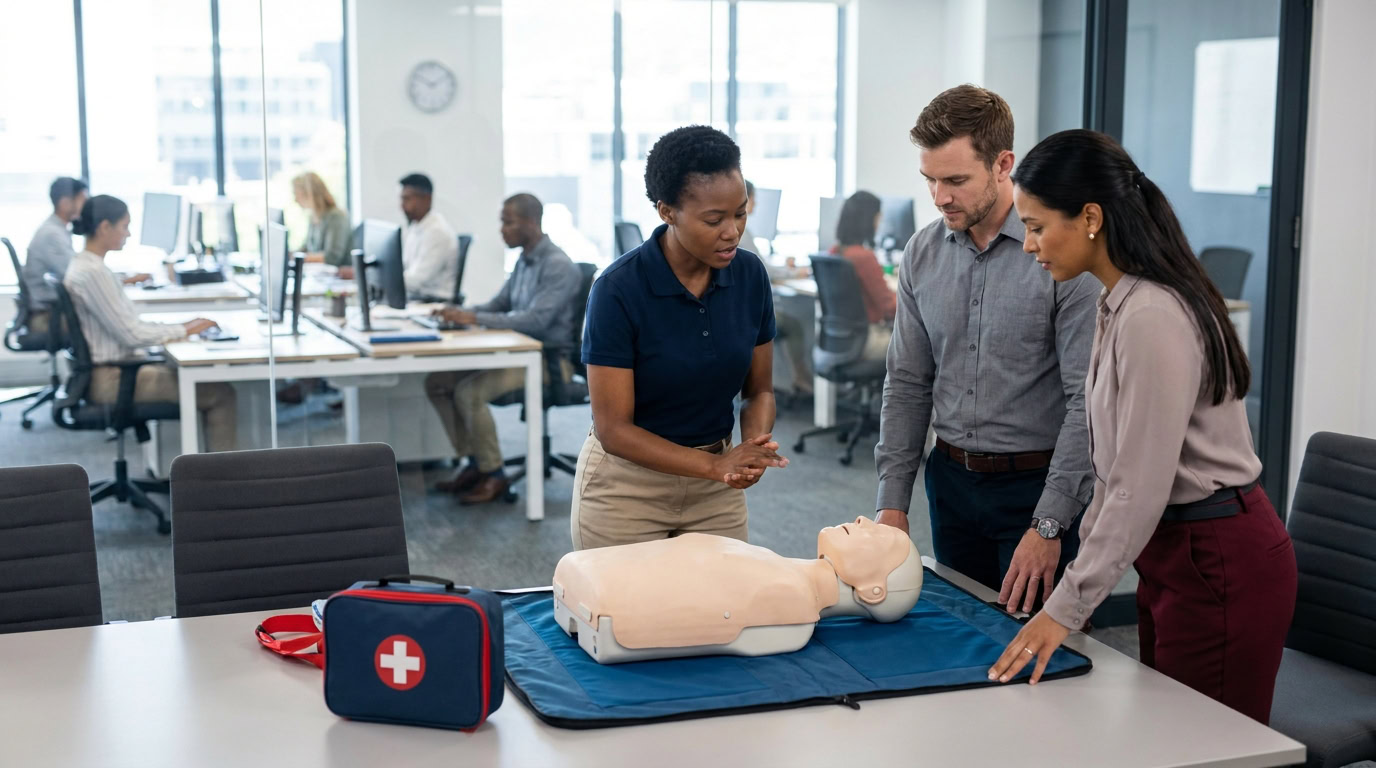
Accredited, OHS Act-compliant training does not have to mean business disruption. With short course formats, phased scheduling, rotation-based planning, national reach, on-site delivery, and online options, it is entirely possible for businesses to meet their legal obligations and keep operations running.
